This piece includes an interview between writer Evan Dressel and Senior Legal Counsel Lee Hepner of the American Economic Liberty Project.
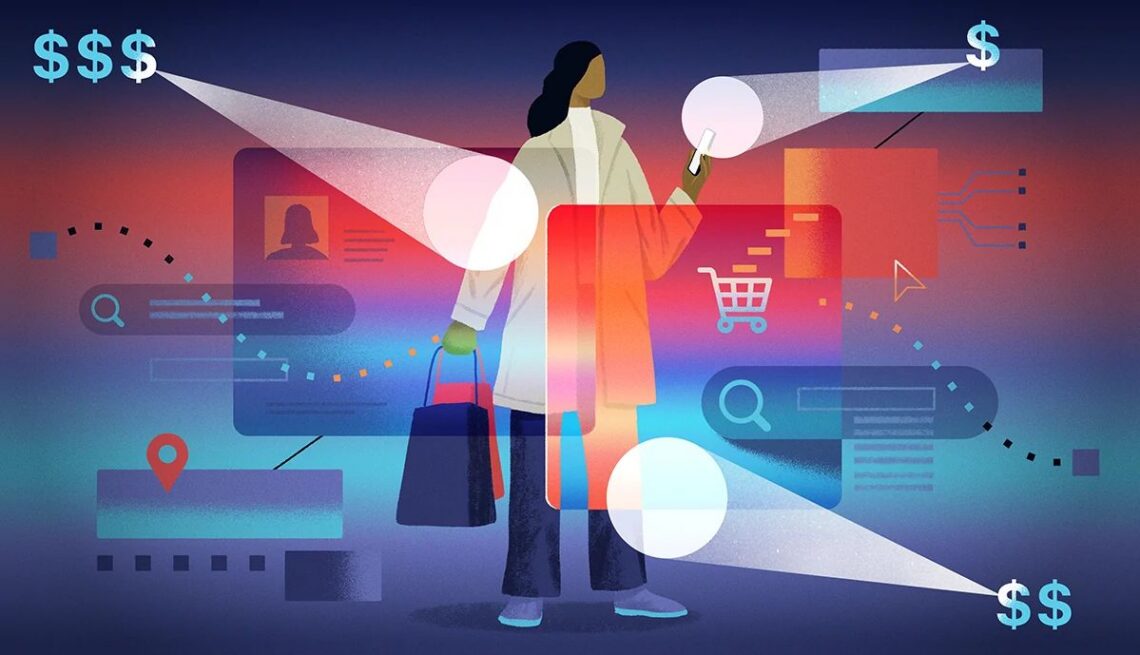
It’s the “holy grail” of consumer pricing. That is what one investor called surveillance pricing. It’s when a corporation can predict your willingness to pay a certain price for a product based on your personal data. This includes your browsing history, subscriptions, and even how long your mouse hovers over a specific item. Since the rise of artificial intelligence, accessing personal data has become easier, making surveillance pricing both more efficient and achievable for corporations.
Surveillance pricing could revolutionize how consumers interact with companies and the prices they encounter. Consumers could see their prices skyrocket or plummet depending on their willingness to pay. The political and legal fight surrounding surveillance pricing is ramping up as more people are becoming increasingly aware of corporations implementing this pricing strategy.
According to the senior legal counsel for the American Economic Liberty Project, Lee Hepner, surveillance pricing is “personalized or individualized price discrimination, where consumers are offered different prices for the same good or service based on a prediction of their willingness to pay an offered price.” It more broadly refers to the practice of using personal data or an algorithm to set individualized prices.
There is an important distinction between surveillance pricing and dynamic pricing, however. Hepner clarified that dynamic pricing, sometimes called surge pricing, is used when the prices fluctuate based on external market factors like higher demand.
Instead of broader market trends or external factors, surveillance pricing is based on personal information collected with or without consumer knowledge. Lina Khan, former Chair of the Federal Trade Commission (FTC), gives the example of an airline company charging a higher price to someone who has to travel across the country for a funeral.
So how is this legal? How is this not price gouging? “I’m not sure it is legal,” Hepner answered. He explained that surveillance pricing might be considered an unfair or deceptive pricing practice. Cases are still in the early stages, and courts are still deciding if certain tactics are legal or not. It is likely that, until the Supreme Court rules on this, corporations will continue to implement surveillance pricing and will fight these cases in court.
Under President Joe Biden, the FTC was investigating surveillance pricing and, more specifically, the third-party intermediaries that corporations were using. Former FTC Chair Lina Khan said, “Initial staff findings show that retailers frequently use people’s personal information to set targeted, tailored prices for goods and services.” But the Trump Administration, with new FTC Chair Andrew Ferguson, effectively closed the investigation.
There are several bills regarding surveillance pricing making their way through Congress now, including the Stop Pricing Gouging in Grocery Stores Act (H.R.4966), the One Fair Price Act (S.3387), and the Stop AI Price Gouging and Wage Fixing Act (H.R.4640). Despite these early initiatives, none of these bills have shown any sign of moving out of committee.
Some states have taken action to limit or ban these practices at the state level, though. New York was the first state to require disclosure of algorithmic price setting, and the Colorado House of Representatives recently became the first state body to pass a law banning the practice of sending individuals’ data through an algorithm to determine a price. Nationally, a few Senators have set their sights on corporations utilizing surveillance pricing, with Mark Warner, Ruben Gallego, and Richard Blumenthal sending a letter to Delta Airlines asking for clarification of its plan to use AI to set individualized air fares.
Concerns about surveillance pricing have increased due to the visibility of AI in consumer markets. Hepner says that the “technology has evolved very significantly to make this much easier to accomplish.”
The explosion of AI makes the processing of personal data quicker and more efficient, enabling companies to use sophisticated AI algorithms to crunch the numbers and find the maximum acceptable price for an individual. This would dramatically increase profits for corporations and will result in increased prices for most consumers.
Hepner says that another effect of surveillance pricing is that consumers will no longer have a proper benchmark for prices. If surveillance pricing is instituted at a broad level, it will equate to price discrimination. This would, according to Hepner, “[Shred] social cohesion and fairness in the economy.”
The tactic of surveillance pricing also puts at risk the typical understanding we have of how our economy works. When prices are individualized and not set for the market as a whole, it can affect our ability to contest unfair prices. Hepner elaborated, “Social cohesion is being shredded by ubiquitous price discrimination,” and that “consumers no longer get to object to a price as a block of consumers dictating demand.”
Some corporations have responded to criticism and investigations of their tactics by claiming that their practice is about finding the best prices for certain products, not maximizing profits by raising prices. For example, a 2025 study found that Instacart, an online grocery marketplace company, placed different prices for the same products at the same stores to different people. Instacart claimed that the different prices were the result of “pricing tests” for the purposes of learning “how to keep essential items affordable.”
Hepner calls this justification an “absolute smokescreen” and a “veil for ubiquitous price discrimination.” By making prices individualized, Hepner calls into question the ability of consumers to know what a truly lower price is. Technically, any price that is lower than the highest offered price is a “lower price” or “discount,” but this is contrary to the general understanding of what a discount is.
When a corporation offers a widely known and accepted form of discount, such as senior or student discounts, they set a standard price for the market as a whole. However, if a corporation knows ahead of time that you qualify for a discount, they can mask the true price to deceive the consumer into believing that the price they are paying is a discount when, in reality, it is the standard price.
Surveillance pricing is likely not going anywhere for the time being. Personal data is more accessible than ever, and technology has made analyzing vast troves of data even more efficient. For the time being, consumers should protect themselves by paying attention to price changes they see online and how they compare with the in-store price.